Blog
How Can Your Municipality Cut Through Equipment Procurement Red Tape?
July 7, 2026A public works director doesn’t lose sleep over which excavator to buy. They lose sleep over whether the purchase will survive a board meeting, whether the bid documentation holds up, and whether the budget request should have gone in three months ago. Municipal equipment procurement is slow by design: bidding rules, fiscal-year budgets, and public accountability all add steps a private contractor never has to deal with. The fastest way through it is cooperative purchasing contracts and starting the budget conversation a full cycle before you actually need the machine.
Why Does Municipal Equipment Procurement Take So Much Longer Than Private Purchasing?
Every dollar a municipality spends has to be defensible to a board, a council, and ultimately taxpayers, so the process is built around documentation and competitive bidding rather than speed. A private contractor can decide on a machine and own it within days. A public works department has to justify the need, source competitive bids or qualify for an exemption, get budget approval, and often wait for the next board meeting on the calendar, and that’s assuming the request was already in the current fiscal year’s budget.
We work with municipalities on this regularly, and the departments that move fastest aren’t the ones with bigger budgets. They’re the ones that stopped treating every purchase as its own bidding event.
How Does Cooperative Purchasing Actually Speed Things Up?
We hold COSTARS vendor status in Pennsylvania and participate in Sourcewell’s cooperative purchasing program, which means a municipality can buy Kubota equipment through us under contracts that have already gone through competitive bidding at the cooperative level. That’s the step that normally eats the most time in municipal equipment procurement, and cooperative purchasing removes it entirely.
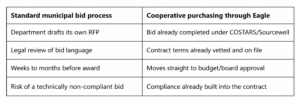
If your department hasn’t purchased through COSTARS or Sourcewell before, we’ll walk through which Kubota equipment is covered and exactly what your board needs to see to approve the purchase under the cooperative contract.
When Should The Procurement Conversation Actually Start?
Start it a full budget cycle before you need the equipment, not after the current machine fails. Municipal budgets lock in annually, so a request that misses this year’s budget window typically waits until next year’s, even when a machine is already on its last repair. We tell department heads the same thing every time: identify what’s aging out of your fleet now, while there’s still time to build it into next year’s budget request instead of scrambling for an emergency appropriation later.
What Does A Board Actually Need To See To Approve A Purchase?
A board isn’t approving a machine; it’s approving a decision, and that decision needs to hold up to questions about cost and necessity. What we help departments put together includes:
- Current equipment age, condition, and recent repair costs.
- A real comparison: continuing to repair the old machine versus replacing it.
- Expected service life of the replacement and what it costs to maintain.
- Cooperative contract pricing, since it shows the pricing was competitively bid rather than negotiated one-off
- How the equipment ties to a specific department function: snow response, road maintenance, parks, utility work
Departments that bring this to a board meeting already assembled tend to get approval on the first pass instead of getting sent back for more information.
What Should You Actually Look For In A Dealer If You’re Buying Under A Municipal Budget?
Look for a dealer that can speak fluently about cooperative contract status and bidding compliance without you having to explain what COSTARS or Sourcewell is. That fluency is what separates a dealer who occasionally sells to government from one who actually understands how public-sector budgets and approval timelines work. Local service and parts availability matter more here too. When municipal equipment goes down, it’s not just one contractor’s schedule at stake. It’s road clearing, snow response, or a utility crew’s ability to do their job.
What Usually Causes Procurement Delays That Are Avoidable?
In our experience, the same few things trip up municipal equipment procurement over and over: waiting until a machine fails instead of planning for its replacement, missing the budget submission window for the fiscal year, bringing an incomplete cost justification to the board, and not knowing which cooperative contract actually applies to the purchase. Every one of these is avoidable with a few months of lead time and the right documentation ready before the budget request goes in.
Conclusion
Municipal equipment procurement doesn’t have to mean months of bidding and budget delays. At Eagle Power & Equipment, Inc., our COSTARS and Sourcewell status lets municipalities buy Kubota equipment through contracts that are already competitively bid, and we help departments build the documentation and timing that gets a purchase approved on the first pass instead of sent back for more information. If your department has equipment aging out of the fleet, the time to start that conversation is before it becomes an emergency.
Frequently Asked Questions
What’s the real difference between cooperative purchasing and running our own bid?
Cooperative purchasing uses a contract that’s already been competitively bid by COSTARS or Sourcewell, so your department can buy under those terms without running a separate RFP process of your own.
Can we use a cooperative contract for service agreements, not just the equipment itself?
That depends on the specific cooperative contract and vendor terms, so we’ll confirm directly whether a given Kubota service agreement falls under the same cooperative coverage as the equipment purchase.
How far ahead should we flag equipment for replacement?
At least one full budget cycle ahead, since municipal budgets are locked in annually and a request that misses this year’s window typically has to wait for the next one.
Does financing work differently for a municipality than it does for a private contractor?
Yes, public-sector financing and leasing terms often differ from standard commercial financing, which is why we discuss those structures directly with each department rather than applying private-sector terms.
What should we have ready before bringing an equipment purchase to the board?
Current equipment condition and repair history, a repair-versus-replace cost comparison, expected service life of the new equipment, and pricing documentation tied to the cooperative contract you’re purchasing under.
Related Articles
Skid Steer vs. Compact Track Loader: Which Machine Fits the Job?

Fluids and Filters: Best Practices for Maintaining Your CASE Equipment

Why the Right Equipment Dealer is Key to Your Construction Business Success

Backhoe Maintenance Tips

Even In The Middle of Winter It Is Time To Get Your Machine Set For Spring

Best Excavator Maintenance Tips to Avoid Costly Downtime
What Should Be on Your Pre-Shift Equipment Inspection Checklist?

New Service Offerings Available to Help You Keep Your Equipment in Top Shape

Preparing Heavy Equipment for Winter

