Blog
Choosing a Plate Compactor for Pavers: Force, Size and Control
November 18, 2026A plate compactor for pavers needs to match the job beneath the surface as well as the finished paving. The machine used to pack the stone base may not be suitable for seating the pavers afterward.
For standard interlocking concrete pavers, the Concrete Masonry & Hardscapes Association (CMHA) specifies a low-amplitude plate with at least 5,000 pounds-force (lbf) of centrifugal force and a suitable vibration frequency for final compaction. Smaller machines may work for some base preparation tasks, but the paver manufacturer’s instructions should guide the final choice.
What size plate compactor do you need?
Start with the paving material and the work area. A narrow walkway may need a machine that’s easy to turn, while a driveway needs a base designed to support vehicle loads.
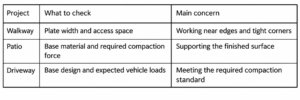
A wider or heavier plate isn’t automatically better. Check the machine’s force rating, vibration frequency and operating weight against the project specifications.
How much compaction force is enough?
Compaction force and machine weight aren’t the same thing. A heavy machine may be difficult to transport, but its weight alone doesn’t tell you how it will perform.
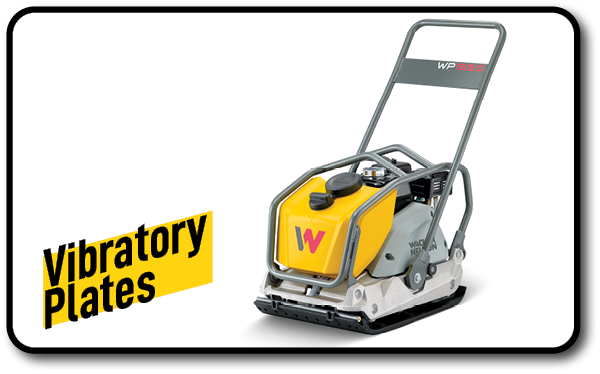
For example, the Wacker Neuson WPU1550AW-US reversible plate has:
- Approximately 3,372 lbf of centrifugal force
- An operating weight of about 227 pounds
- A plate width of roughly 19.7 inches
Its force rating falls below CMHA’s 5,000 lbf benchmark for seating standard interlocking concrete pavers.
That doesn’t rule it out for every paving application. It means the contractor needs to check the requirements for the specific material and stage of work.
How to compact the base and finished pavers
Compact the stone base
Compact the stone base in layers to create a firm surface. Layers that are too thick may remain loose underneath. Follow the project’s base requirements and use a plate suited to the material and layer thickness.
Compact the finished pavers
After laying the pavers, use the plate to settle them into the bedding sand. Add joint sand and make the required passes according to the paver manufacturer’s instructions. Make sure edge restraints are installed before compacting near the edges.
Single-direction vs. reversible plate compactors
A single-direction plate moves forward and works well in open areas with room to turn.
A reversible plate moves forward and backward, making it easier to work near walls, steps and tight spaces.
For smaller jobs, consider the machine’s weight and ease of handling. For larger jobs, check its compaction force and suitability for the base material. For other compaction machines, read our guide to types of rollers used in compaction work.
How to protect pavers during compaction
A steel plate can scratch or damage finished pavers. Check whether the paver manufacturer requires a protective mat. Remove loose stones before compacting and follow the recommended method.
Natural stone, porcelain and specialty pavers may need different equipment, so check their installation instructions first.
Find the right Wacker Neuson plate at Eagle Power & Equipment
At Eagle Power & Equipment, we’re here to help you choose a plate compactor that fits your project. As a Wacker Neuson dealer, we offer single-direction and reversible plates for soil, asphalt and paving work.
Share your project details and paver requirements with us. We’ll help you compare suitable options. Contact our team to discuss your equipment needs.
FAQs
Can a lightweight plate compact the base but not the finished pavers?
Yes. A lightweight plate may be suitable for certain base materials and lift thicknesses while falling below the force required for seating standard interlocking concrete pavers.
Can you compact pavers over frozen ground?
No. Don’t install pavers over a frozen base or use frozen bedding sand. Wait until the ground and materials meet the installation requirements.


